

Please note that this information is for reference only.
Please consult your clinician for more information.
What is Atopic Dermatitis?
Atopic dermatitis - commonly referred to as eczema or atopic eczema - is a chronic itchy skin condition associated with asthma and different types of allergies and sensitivities. Family
history is often present.
Patients with atopic dermatitis experience unpredictable flares, and there are many different triggers for this disease.
Some environmental triggers can be avoided, but many others, including heat, sweating, and the change of seasons, are harder to avoid.
We do not have evidence that avoiding certain foods will improve atopic dermatitis in adults unless specific food allergies have been present since childhood.
Atopic dermatitis usually starts in childhood, and while some people get better with time, most patients will always have sensitive skin. In some cases, atopic dermatitis persists into adulthood and may continue to worsen with time.
Adult atopic dermatitis is characterized by intense chronic itch, and can cause lasting skin problems, including scarring and changes to the colour and thickness of skin, as well asa wide range of problems associated with unpredictable disease flares, open wounds and secondary infections. As a result, this disease impacts patients sleep, work, and social life, triggering anxiety and depression.

Why Do I Have Atopic Dermatitis?
Genetic factors play a role in this disease, and patients with atopic dermatitis often have a family history of atopic dermatitis, asthma, hay fever, and/or allergies.
Active disease flares and skin lesions involve the skin barrier, but importantly also involve the immune system.
Think of your immune system like a tree, with branches for fighting bacteria, viruses, and other environmental threats; in atopic dermatitis, a branch of the immune system is overactive, leading to inflammation. To control this immune response, your doctor has different tools to either shrink the tree, or to selectively cut off the overactive branch.
What Can I Do About It?
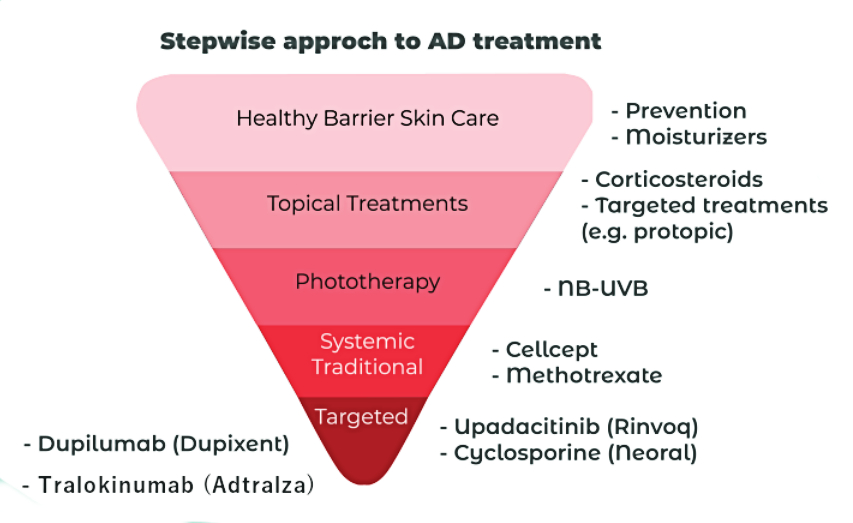
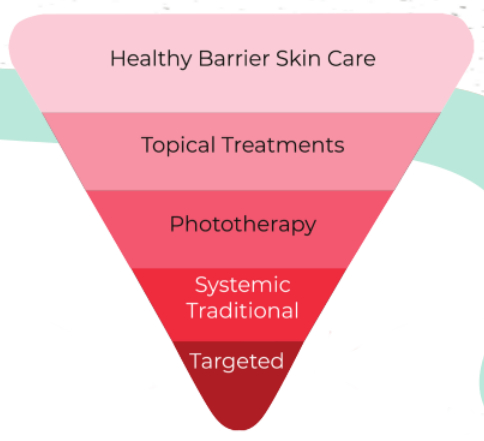
1. Proactively maintain a healthy skin barrier
The surface of normal skin acts as a tight seal, like a waterproof layer. Our skin evolved to contain moisturizing factors that help attract and boost water content within skin cells as well as oils (also called lipids).
People with atopic dermatitis can be missing key elements of this skin seal, including proteins and oils that help keep the skin healthy. A 'leaky' skin barrier allows damage to deeper layers of the skin and allows moisture to escape, contributing to dryness. People with atopic dermatitis also have skin that is more sensitive to their environment.
Maintaining a healthy skin barrier is key to prevention; this means ALWAYS keeping the skin 'sealed' with moisturizing creams and ointments, especially after bathing or exposure to irritants, including harsh or changing weather, sweat or exercising.
Moisturizers
For mild atopic dermatitis, frequent and consistent use of moisturizers may be enough to prevent flares. In moderate to severe disease, other medications are added to this essential foundation of care.
Which moisturizers
Think of choosing a moisturizer like choosing shoes; you will need different ones for different occasions. Currently, there is no evidence that one brand is better than any other; there are many good moisturizers to choose from, and your preference is important. Ingredients like glycerin, urea, ceramides, and fatty acids help prevent evaporation.
Using moisturizers
1. Choose moisturizers that are soothing and do not irritate the skin.
2. Avoid products that contain fragrances and/or 'natural' extracts. Instead, try to choose hypoallergenic moisturizer.
3. Choose ointments or creams instead of lotions: thicker products last longer.
4. Use lots! Generous, daily use is more important than the specific product used.
5. Use a full shot-glass, or 2 full tablespoons (30g), of moisturizer to cover the body.
6. Apply immediately after bathing or water exposure while you are still damp.
7. Vaseline is safe to use even around the eyes and genitals, and is a good inexpensive option.
Skin hygiene
The skin has evolved to protect us with a ecosystem of normal and healthy bacteria that contribute to a healthy barrier. The skin renews itself constantly and does not need soap on most body parts to stay healthy.
Which cleansers?
Many soaps can worsen skin health and cause an imbalance in the skin's ecosystems. This is because soaps, particularly liquid soaps, can change skin's pH, from it's healthy base level of 5.5. Water itself can also be irritating, removing protective layers of oils from the skin barrier. Finally, rubbing, scrubbing, and towelling can be very a irritating, especially to sensitive skin.
What to do in the shower or bath:
- Bathe or shower only once a day, or every other day, as needed.
- Don't soap!
- Remember that most of your body surfaces only need to be rinsed with water
- Only use soaps to areas that are odorous, such as the armpits or genitals
- Avoid liquid soaps, unless they are a specifically labeled synthetic detergent or 'syndet', with a balanced pH
2. How to calm overactive skin inflammation locally
Topical treatments are applied to calm skin inflammation locally. Topical medications should be applied directly to red, rough, itchy skin on a regular basis.
There are a wide range of topical treatments, and you may need different ones at different times and/or for different areas of the body. There are two broad classes of topical medications; 1. 'traditional,' and 2. 'targeted,' and these may be formulated as lotions, creams, or ointments.
Traditional topical medications work broadly, and sometimes have a wider range of side effects. Newer 'targeted' medications are designed to act more specifically, and often have more limited side effects. However, targeted treatments may be more expensive.
The choice of active treatment depends on the severity of skin inflammation and the body site.
Traditional topical medications
Corticosteroids
(these come in wide range strengths and formulations)
- Mild strength, e.g. hydrocortisone
- Medium strength, e.g. Aristocort-R, triamcinolone or Betaderm, betamethasone
- Very strong, e.g. Dermovate, Clobetasol propionate
Targeted topical medications
- Calcineurin inhibitors:
Tacrolimus (Protopic), Pimecrolimus (Elidel) - Phosphodiesterase-4 inhibitors:
Crisaborole (Eucrisa)

How to use 'local' topical treatments
1. Be sure to use enough treatment to cover all of the rough itchy areas affected
2. Use regularly, until the rough itchy skin feels smooth again for at least few days
3. Keep treating areas where flares recur, at least twice a week, as a preventative treatment
Tips for topical treatments
Percentages, e.g. 0.01%, 0.1%, are not used to compare between different medications, but rather to distinguish strength.
The word 'TARO' on your medication is used to indicate a generic (non-brand) name.
In general, skin on the hands and feet is much thicker and needs stronger treatments. Thin skin on the face, neck, and genitals needs more gentle treatments.
3. Prevent skin immune overactivity long term
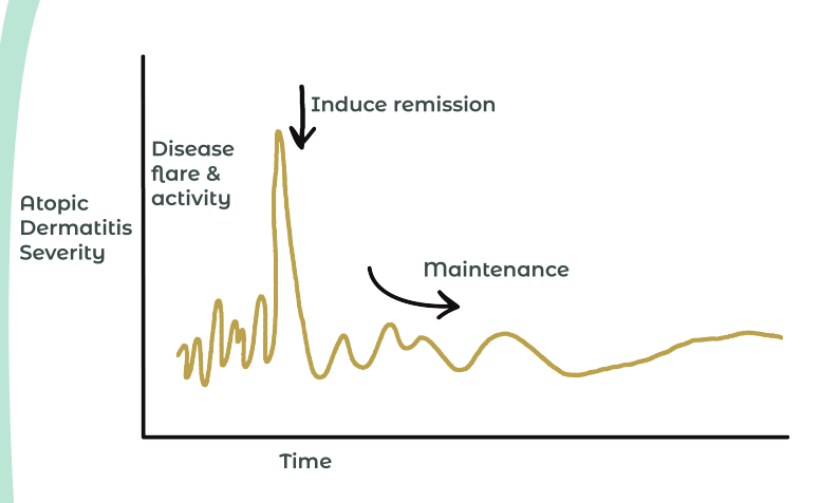
When topical treatment is not enough, phototherapy (light or NBUVB) or systemic therapies (tablet/pill or injection) may be used to put atopic dermatitis into remission (i.e., put the disease to sleep). These treatments prevent overactive immune responses that cause flares of itchy skin and inflammation in atopic dermatitis. Phototherapy only penetrates the skin, while systemic therapies (tablets/pills or injections) treat more globally and have different considerations and side effects.
If you need systemic medication to manage your atopic dermatitis, you will likely need to try different treatments over time. This treatment journey will reflect many variables, including your personal choices, your disease and its flares, and your daily activities, as well as cost and the accessibility of treatments. You may be prescribed one or two types of medication to put your atopic dermatitis into remission (i.e., put the disease to sleep) and then be switched to another medication for long-term maintenance. Currently, we do not have any medications that give a lasting cure. Ongoing research and more information is needed.
Phototherapy with narrow-band-ultraviolet B (NB-UVB) light
Exposing skin surfaces to a specific, narrow band of UVB rays can help manage atopic dermatitis and itch. This treatment generally requires three visits per week to a center with phototherapy machines (visit www.dermatoqc.org, and search 'Phototherapy' using your postal code). The number of treatments required to achieve remission and maintenance varies from person-to-person. The risks are similar to those related to sun exposure, hough to a lesser degree.
Systemic therapies
(Tablets/pills taken by mouth, or injections)
There are two broad classes of systemic therapies; 1.'traditional,' and 2.'targeted.'
Traditional medications work broadly, and sometimes have a wider range of side effects. Newer 'targeted' medications are designed to act more specifically, and the newer targeted treatments may have a more limited set of side effects. Targeted treatments may also be more expensive.
Newer targeted treatments are used for atopic dermatitis that fails to be treated by other medications.
Traditional systemic medications*
Oral tablets/pills:
- Prednisone (*not recommended. only given as a 'riscue' medication during flares)
- Methotrexate (also available by injection)
- Mycophenylate Mofetil
- Azathioprine
* Except for prednisone, the following traditional systemic medications inhibit cell metabolism so that inflammation has less 'fuel'.
Targeted systemic medications
Oral tablets/pills or injections:
- Cyclosporine (Neoral), oral tablets/pills
- Rinvoq (Upadacitinib), oral tablets/pills
- Dupilumab (Dupixent), injection
Traditional systemic medications
Methotrexate
An anti-inflammatory medication that has been in use for decades, methotrexate tablets or injections are taken once a week. Results are apparent after about 8 weeks of treatment. Side effects vary from person-to-person, but it is usually well-tolerated. The risk of side effects is higher in obese and/or diabetic people and especially among those who regularly consume alcohol. Short-term side effects include changes in blood counts, or gastrointestinal symptoms (nausea, upset stomach). Side effects from prolonged use include possible liver damage; this occurs mostly in people who regularly consume alcohol. A supplement of folic acid (vitamin B9) is given to reduce side effects.
Blood tests at regular intervals are essential for monitoring. This drug is also contraindicated when pregnancy is being actively considered.
Azathioprine (lmuran)
A 50mg tablet immunosuppressive medication used since the 1950s; doses of 100mg to 200mg are taken orally once daily. It can take up to 12 weeks to see results. Common side effects include nausea, vomiting, and diarrhea. Consuming alcohol while taking azathioprine can cause liver damage; alcohol consumption should be limited or stopped. Blood counts can also be impacted by azathioprine, and in particular, there can be decreases in red blood cells, white blood cells, and platelets. There is an increased risk of infection.
Regular blood tests are required for monitoring. There is also a higher risk of certain types of cancer with long term use. Rarely, there have been reports of hair thinning.
Mycophenolate mofetil (Cellcept)
An immunosuppressive medication that is available in tablets of 250mg and 500mg, and is given in doses of 500mg to 1500mg orally twice daily. Side-effects include nausea, diarrhea, headaches, and sores in the mouth. These common side effects increase with higher doses. Rare side effects include infections and cancers.
Regular blood work is required to monitor blood counts. This drug should be avoided if pregnancy is being actively considered, and appropriate measures should be taken to avoid pregnancy while taking this medication.
Targeted treatments
Targeted treatments are designed to control a small, specific branch of the immune system that is overactive in a topic dermatitis. They are more selective and tailored to the disease's underlying mechanisms. They may provide effective therapeutic outcomes with fewer off-target effects than non-targeted treatments, with the potential for fewer safety concerns. However, access is often limited by cost.
Cyclosporine (Neoral)
Cyclosporine is highly effective for the treatment of atopic dermatitis and for putting disease into quick remission; the disease is usually controlled within less than 1 month. The short-term side effects include tingling in the fingers, stomach upset, and increases in blood pressure (this must be closely monitored every week). An elevation of lipids (fats in the blood) also must be monitored by regular blood tests. If used long term (over 2 years of continuous use), this drug can cause more side effects due to its impact on the kidneys and overall deleterious impact on the immune system. For this reason, cyclosporine is usually prescribed only short-term, or as a bridge to other maintenance treatments. Regular blood work is essential to check kidney functions. Side effects vary depending on the required dose and duration of treatment: the higher the dose and longer the period of use, the greater the risk to the kidneys.
Upadacitinib (Rinvoq)
Upadacitinib is a medication taken once a day by mouth. It attaches to an enzyme of the immune system called Janus kinase (JAK) and slows it down. This calms inflammation and can treat atopic dermatitis that does not improve with other treatments. While taking upadacitinib, you should continue using topical treatments for small flares. Common side effects include headaches, nausea, cold sores, back pain, acne, fatigue, and hives. These side effects also affect people with untreated atopic dermatitis. Infections can become harder for your body to deal with while you take upadacitinib, and you will need blood tests before you begin upadacitinib to make sure it is safe for you to take. ou will also need blood tests while taking upadacitinib. Talk to your doctor if you get an infection while taking upadacitinib or start experiencing muscle pain or weakness. Very rarely, patients taking upadacitinib had an increased risk of blood clots and certain types of cancer. Talk to your doctor about any concerns you may have.
Dupilumab (Dupixent)
Dupilumab is a biologic treatment that targets the specific branch of the immune system involved in atopic dermatitis. Biologics have been used to treat other skin diseases like psoriasis, for many years. Dupilumab is administered by subcutaneous injection (below the skin). Two injections are given initially, followed by one injection every 2 weeks. Common side effects include eye inflammation (especially conjunctivitis), headaches, and cold sores. If you have asthma as well as eczema, you could experience a sudden worsening of your asthma if Dupilumab is stopped. Overall, Dupilumab is a safe drug that is generally safer than any of the immunosuppressive or anti-inflammatory medications. While taking Dupilumab it is still important to use moisturizer on a regular basis. If there are small flares of disease, topical steroids or calcineurin inhibitors can be used. Ongoing bloodwork is not required while taking Dupilumab.
Atopic dermatitis is a 'heterogeneous' disease, which means that it varies according to age, race, and ethnicity.
As a result, individual treatment approaches are needed.
To learn more, please visit:
- www.eczemahelp.ca
- www.bidermato.com/accueil
- www.canadianskin.ca/en
- www.eczemacouncil.org
- www.globalskin.org
- www.parentsforeczemaresearch.com
- www.nationaleczema.org
- www.eczematherapies.com